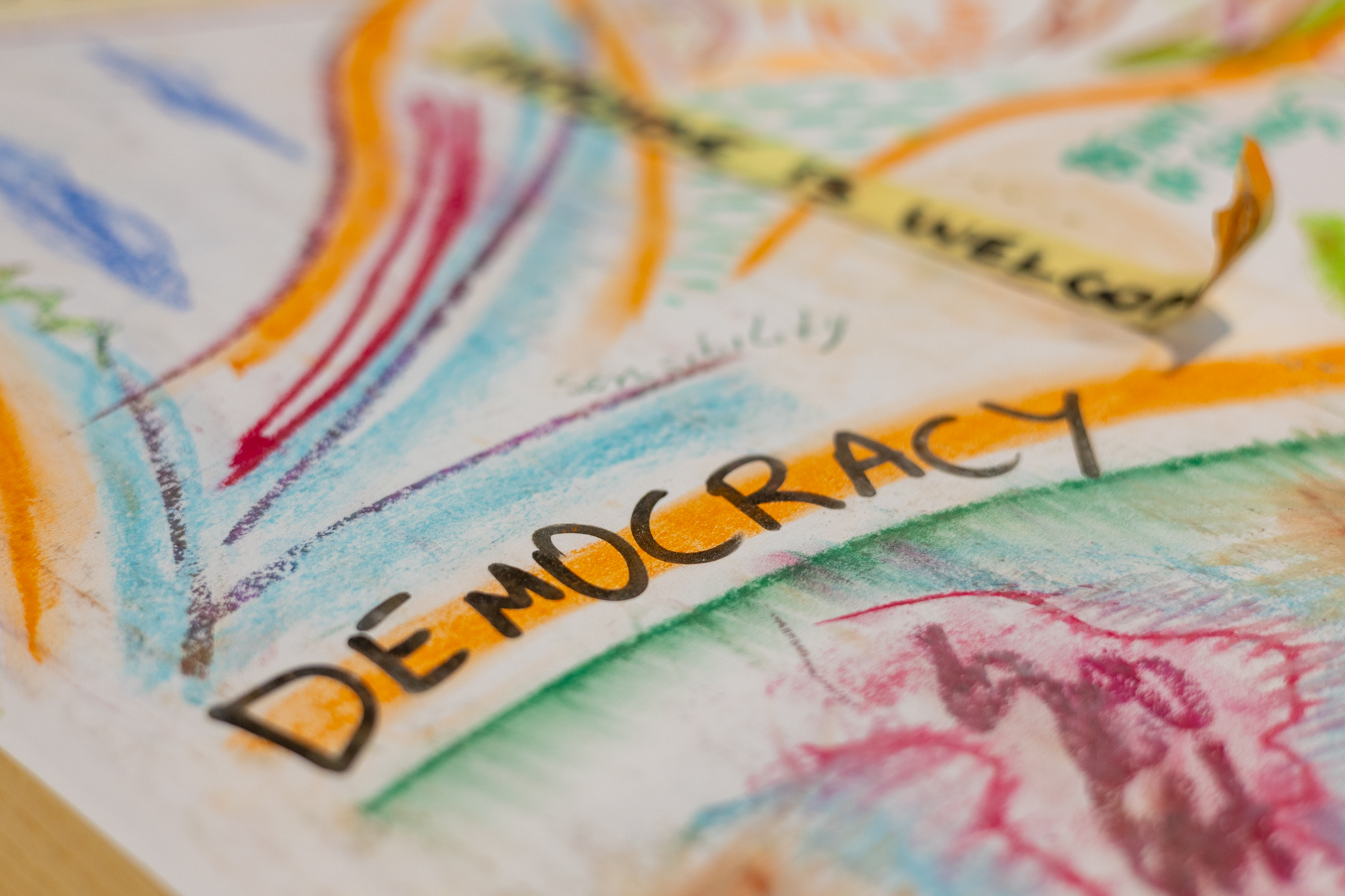
This past week, I have been at Aalto University, participating in a wonderful residency exploring ‘pedagogies of togetherness’ with a fabulous group of people from around the world. It’s been a wildly inspiring, completely overwhelming and profoundly hopeful experience. I’m still in Helsinki and only slowly gathering my impressions, thoughts and ideas that is already starting to grow.
There’s much more to say about all this, but I’m not ready for that. For now, I just wanted to share a short manuscript I quickly wrote to record a little video with my reflections from the week:
My name is Mathias Poulsen, and I work in Lab for Play Design at Kolding School of Design in Denmark.
I’m particularly interested in play as a way of life that follows us through life. Play is not for children only, but for all of us, even beyond the human species. I also believe that play has a unique capacity for us to explore other ways of living together, other possible worlds, and other ways of engaging in democratic life.
I have a feeling that we created a world full of systems, structures and logics that are alienating, maybe especially to young people. This puts us in a very difficult position trying respond to the massive challenges of our time, including escalating climate change, rampant inequality, multiple forms of oppression, all these forces that are shaping the wild and complex polycrisis we are currently overwhelmed by. If we are disconnected from democracy, from each other, and from earth itself, then it’s understandable that we – and young people – feel a growing sense of apathy.
What can any of us ever really do on our own?
We urgently need to nurture a sense of agency and cultivate the hope that we can create better ways of living together.
When I’m with younger people, especialy when I’m in the role of a teacher, I try to frame the activity as something we do together. I am more interested in that which might occur and emerge between us than whatever I myself bring to the table. Teaching and education is always, first and foremost, a relational endeavour. It is something we do, something we can only ever do, together.
I think of play as an art form in itself. The body and movement is often activated through play, by playing with others and in the playful encounters of everyday life. When we play together, we can more easily get out of our heads, into our bodies and step closer to each other. I always try to make space for the body, for moving, for playing, for engaging with each other, and for cultivating ways of knowing that are less bound to rational, cognitive knowledges. Many of these practices are very simple and easy to do, such as games that involve the body and the senses, or reflecting, writing and telling stories with tangible materials.
If I allow myself to dream, I can imagine education at large shifting from the current modern obsession with autonomous, rational individuals towards growing much stronger relational roots. That would generate learning spaces where the most important thing is what unfolds in the space between us. In this future, we would all be less concerned with individual achievements, with grades and exams, and much more interested in relations and connections. It would no longer merely be about what any one person can know, but what we might become together.
This radical transformation would also require us as educators to appreciate a much wider landscape of knowledge. Where we currently have built our systems primarily on knowing with our heads, we will instead embrace knowing with our whole body, with our senses, by establishing and maintaining the connections we have lost – to each other, to society, to the more-than-human world and to the earth.
Fortunately, there is a growing community of people committed to the pedagogies of togetherness, and I can only encourage you to join. The pedagogies of togetherness always grow and transform through our relations, so my biggest wish is that we can maintain a lively, ongoing dialogue and cultivate open, vibrant communities across our beautiful differences.


Leave a Reply